Showing posts with label UAF. Show all posts

Tuesday, 30 June 2009

Another UAF rally, but where next?


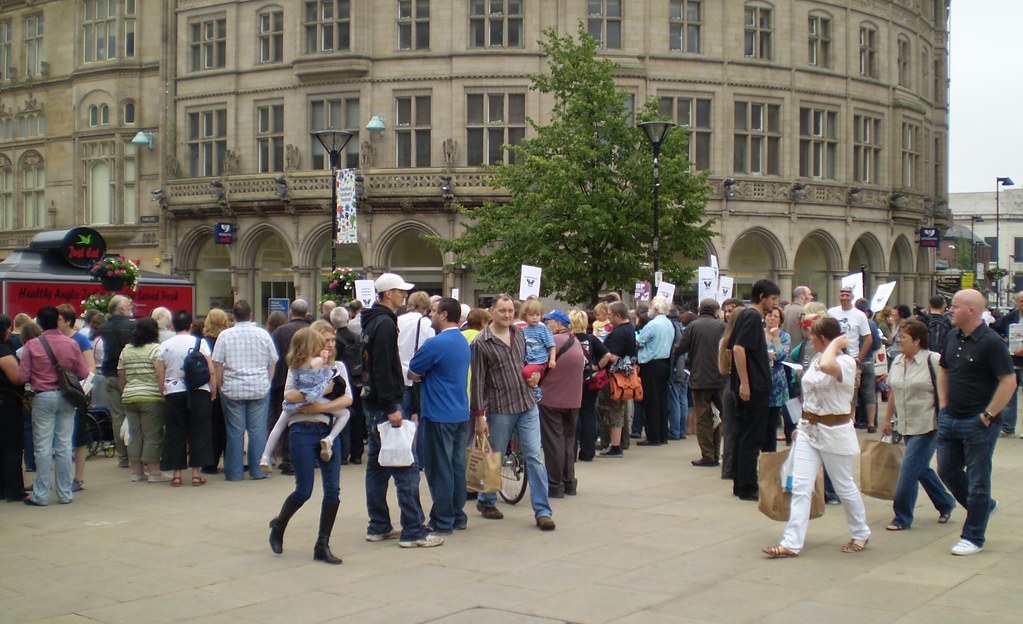
Well, Saturday saw the latest anti-BNP rally by the UAF, and it was much better in some ways, but much worse in others.

First the positives, of which there were quite a few. The range and diversity of speakers was far greater this time, with all the main parties in Sheffield represented, as well as several minority ethnic groups, LGBT, students, and with unions being no longer dominant but a welcome part of the mix. The stalls and handouts were still mostly socialist kinds of material, but I gather the organizers have little control over which groups turn up to flyer an event. The crowd also seemed much more diverse, and I think at times I was surrounded by people who probably don't go to that many protests.

Some of the speakers were excellent, and some even managed to avoid over the top description and hatred against the BNP, concentrating instead on the people who voted for them and the need to reconnect with these people. One speaker in particular stressed that the situation of some people in the Sheffield area meant the BNP had fertile ground for their views, and had more attention been paid to these people's needs in the past the BNP would not had gained so many votes as they did.

However, there were several negatives, and one glaring fuck-up in the form of an illiberal and very misguided speaker. The first problem was frankly the turnout: the official organizers said only 150 people came to the rally, which is potentially less than the previous two. I would be more though and say the crowds were roughly equal, but when this was organized well in advance and was supposed to be something larger, it's very disappointing. Perhaps part of the blame can be laid with the location, having been shifted from Barker's Pool to the Town Hall at a late date, and then further onto Fargate without any prior notice. Maybe one or two people got lost and could find it, which is unlikely, but I'm being generous here as I won't be so in a second.

The reason why not to be generous is well, to be honest, having been to all three rallies/protests since the elections, I don't think they have much of an answer to the BNP problem. There are only so many times you can say, 'Down with the BNP!' and 'We need to work together!' before you wonder what the next step is. I'm happy to come out and protest against the BNP, and maybe that will be really useful in the run up to the next general election, but what else? I hope that over the summer they'll formalize and organize a more solid campaign to deal with why people have voted BNP and to persuade them not to in the future. I would like to be part of that, as I really would like to do something, because otherwise attending UAF rallies just feels like a sticker for being a good person. That's nice, but ultimately gets us nowhere.

Okay, I'm far too harsh on the UAF. I'm sure they're good people and try hard, I would just like to see so much more as the BNP are increasingly coming to define the political debate for some parts of the population, and that's where the real fuckup from this rally comes into play. There was a speaker (I won't name him, sadly) who decided that the best way to deal with the BNP was to withdraw their political rights, specifically the right to free speech. Yup, he thinks that a political party which already leans hard on its 'outsider' status should be handed the biggest free gift ever. Not only will it cement its place as an anti-politics party, but it will make their supporters so much harder to reach. Such a move will signal to their supporters, the people whom we most need to reach out to, that they're completely denied access to the normal political processes. Damn right we need to avoid debate with the BNP on their, and we need to oppose their hate, but in order to challenge their analyses of problems you don't engage with their supporters by first labelling them unconscionable. I want to see current BNP supporters another way of understanding why they are having problems with housing an employment, but you have to be willing to speak to them, and to let them speak to you. The speaker was heckled, and I wish I had heckled him too. I refused to clap his suggestion and consider him just as dangerous as the BNP. There, I said it.

Friday, 12 June 2009

A united front?

There was another anti-BNP protest today, organized again by Unite Against Fascism (UAF), who also organised the recent egging of Nick Griffin and Andrew Brons outside Parliament. The meeting was slightly different and better organised, as there were stalls, more leafletting, and thankfully a PA system. The turnout was a little lower, maybe around 150-200, but I didn't recognize many there who were at the previous protest. I heard all the speakers, and definitely agree with the sentiment, though more or less with the arguments.

The aim of the meeting this afternoon was about recruiting people to distribute leaflets much more widely and get the message out for a large rally to be held on 27 June at 11am in Barker's Pool. That square can easily hold 1000 people without looking near full, and it would probably take three times that amount to get a crowd that looked like it dominated the space and not the other way round. Sadly, I don't think they're going to get more than 1000 people, and maybe many less.

Why? Well, it's not that the UAF is a terrible organization, it isn't, as it has been taking the lead on this issue since well before the European elections, and that's to their credit. The problem is that isn't able to connect beyond the audience it already has. There are three points where I think it must improve if it's going to build the level of support needed to be successful. The order is deliberate, with the first being the easiest and the one they could implement within two weeks.

1) All three of the stalls and all but one of the seven speakers were from socialist groups or unions. (I'm including the UAF in this count, as although it does have broad support from the three major political parties and various independent groups, its main backers and organizers are from unions.) Of the three stalls, one was for the UAF which is expected, but the other two were for the Socialist Party and the Socialist Worker. Of the speakers, one was UAF, five were from unions (although one of these was a local students' union, which is not exactly the same thing), and the remaining one from an Irish community group.

I don't want to sound harsh, or dismissive of these groups, but they simply don't provide a full spectrum of citizens in the city. I understand that the three main political parties have agreed in Sheffield not to campaign against the BNP to avoid the impression that they're 'ganging up' on them, and instead leave it to community and other groups. But why where these groups not better represented? Maybe they had been invited but turned it down? I don't know. All of the speakers mentioned the need for those threatened by the BNP to come together, to build a coalition of faiths, enthicities, sexualities, political beliefs, disabilities, but only one speaker actually represented any of them. The non-UAF groups and literature present was not only tangential to the cause, but created a 'branding' for the protest that I feel would put many people off.

The UAF shouldn't tell these groups not attend, as that too would prevent the creation of a broad coalition. But it should work hard to get other groups to come along too: promise them a chance to speak, space for their stall, and that they won't be second play to the socialists and unionists. Relevant groups must exist in Sheffield, and they too will have their own supporters and networks from which the campaign can benefit. I don't know if this lack of diversity in groups is the same all over the country, or just here, I haven't been to meetings elsewhere. But there needs to be all kinds of people and speakers at the next rally, as these groups must represent themselves in the campaign.

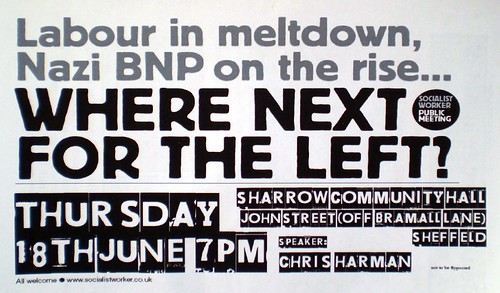
A Socialist Worker flyer handed out at the meeting.

2) The language used in attacking the BNP sometimes seemed misplaced. Not all speakers, but one or two in particular, spoke in a way that I found alienating due to its hyperbole. Nobody should shrink from calling the BNP fascists, and racists, and xenophobes: because that's what they are. Nor should we apologize for campaigning vigorously against what is, admittedly, a small and relatively powerless political group: because we know that they're dangerous and need to be tackled now. However, the continual use of the phrase "Nazi BNP" strikes me as ill-considered. Making the statement once that the BNP are linked to the Nazi party, is important and necessary. Reminding listeners that they share ideology and beliefs allows for an obvious and useful comparison. But constant repetition, the unfailing preceding of "BNP" by "Nazi" as if though we don't know who the BNP are and we can't remember what they stand for is not only insulting, but likely to lead to a devaluation in its rhetorical power. We use wisely what we use sparingly.

Likewise, one speaker made a brilliant thought out argument about hate crimes. She spoke about how the presence of a locus of hate in a community (in this case a bookshop) lead to a normalization of hate, and a consequent rise in hate crime. This is understandable, this is something I can connect with and take with me when I think about why I want to stop the BNP, and inform any actions to stop even the seeds of hate from being scattered. But another speaker ruined this message. She sledgehammered the Holocaust into her speech, almost promising that it was only one election away. It was out of proportion, and it wasn't something I could use. I felt that were genocide really to be taking place I would be powerless to stop it, yet I knew the likelihood of it actually happening soon was ridiculously small. Her words and her images demotivated me, but not because I disagreed that genocide is a bad thing, rather because they stripped me of power and credulity.

Language must be moderate and careful, and it must reflect in the listener their own understanding of both what is happening, and what can be done.

3) There seemed to be little reconciliation with those who voted for the BNP. Only one speaker mentioned that their success was partly a protest vote against not only mainstream political parties but the conditions they find themselves living in. She recognized that they have to be offered something else, something they can grab onto if they are to let go of the BNP. I agree with this, very strongly. Racism and intolerence is undoubtedly present in those communities where the BNP was strongest, but so is poverty and deprivation. The idea of scapegoating others must be very appealing to those who see problems all around them, and this is why the BNP succeed in capturing so many votes. The number of people primarily motivated by racism is probably small in comparison with those who just want to feel like there is some kind of solution to their situation.

Without giving these voters another way of conceiving of the social and economic landscape, attacking the BNP is akin to attacking them, and that could make matters worse. Ignoring the reasons why they voted BNP for fear of validating their worldview won't lead anywhere. Of course no campaign against the BNP should debate on their terms, but it should address the very real greivances people have, and seek to offer an explanation that doesn't rely on scapegoating.

----

Well, another very long post. I hope the rally on 27 June goes well and is well attended. I aslo hope to be there myself, and will be looking and listening to see how they intend to move the campaign forward.

Edit: There was a member of a faith group present at the Monday protest, which goes partly to my first point. Obviously though, the fact that I was at that rally and wasn't aware he was there still makes the point more or less valid.


Tuesday, 9 June 2009

Sheffield ≠ BNP heartland

I arrived back in Sheffield yesterday from a week away. I had watched the European election from a distance, and was dismayed when the voting figures for BNP in the Sheffield area were released. Nearly 17% in Barnsley, 15% in Rotherham, and 12% in Doncaster (though over 20% voted for either the BNP or the English Democrats, which may be relevent). I suppose the city of Sheffield came off rather well at "only" 10% supporting the BNP. Of course, we shouldn't think ourselves any better with that level of support, with that many people in the city who believe the BNP's message.

It was this 10% figure I was thinking about as I left the train and started the long walk up the hill to the city centre. I had thought Sheffield was a fairly well integrated place, comfortable with different cultures and different races. Perhaps even somehow special, like out of all the places in the north with a diverse population, we had managed to be especially tolerant and accepting. But I was wrong, and feel not only stupid for being wrong, but also ashamed for not taking those who said this could happen more seriously, and working to prevent it.

As I lugged my case up Surrey Street, along the side of the Town Hall, I thought to myself, 'Where are these people? Do they live isolated out on an estate or in a suburb, in an enclave where they can ignore the reality of the people and the city around them?' I just hadn't seen that much racism in Sheffield ever, even though I guessed there must be some somewhere. Perhaps there were whole areas I didn't frequent where racism was the norm. But 10%? As I entered the top of Fargate I thought, a little foolishly, that one out of every ten people I see is a racist. I knew it wasn't true, at least because the turnout meant that maybe two thirds of people hadn't voted, but it was enough to make me want to be among the other nine.

It was at that moment I heard a number of people clapping, and turned to see a rally gathered outside the Town Hall. The placards clearly laid out that the rally was against the BNP, but it probably would have been obvious anyway. I crossed the road with my luggage and joined the crowd. There was a couple of hundred people, from all different backgrounds I suppose; though I only recognised some queer people and some students, but that probably says more about me than anything else. I think like me, many who were there just wanted to get out and make a point that not only do they oppose the BNP, but that for the sake of the 90% we must be seen to do so. (Some fotos of the rally are here.)

I'll admit right now that I couldn't hear the speakers at first. When I arrived the speaker on the steps was Paul Blomfield, and unfortunately he was very quiet. I clapped along with the crowd, not through mindlessness, but because I knew that being public in my support was most important. Later I got a little closer, and the speakers a little louder, especially the local leader of Unite Against Fascism (UAF), who was quite forthright on the BNP, but I agreed nonetheless.

Near the end, somebody came up behind the crowd and shouted something, which sadly I didn't catch. The police ran him down Fargate, and a couple dozen of the crowd followed. I wanted to know what was happening, but was hampered by my luggage. Once the rally was over, I dropped my case off at my flat, and returned to the Town Hall, where some people were still milling about, and two drummers had turned up to provide rhythms...